

Death for Life (Genesis 3:20–24)
In this message titled “Death for Life,” Pastor Ben Smith, Sr. examines one of Scripture’s earliest glimpses of redemption in Genesis 3:20–24. When Adam named his wife Eve and God clothed them with garments of sacrifice, He revealed a powerful truth: redemption and new life do not come by ignoring sin, but through the death of a righteous substitute.
Through this passage, we see how God’s grace, justice, and mercy meet at the cross of Christ—the ultimate fulfillment of His promise in Eden. Discover three key truths about redemption: it requires faith, a righteous sacrifice, and the gracious work of God alone.
Join us as we trace the doctrine of penal substitutionary atonement from the Garden to the Gospel and learn what it truly means to find life through the death of Christ.
“Redemption and new life in Christ do not come through ignoring or excusing sin, but through death and the substitutionary atonement of a righteous sacrifice.”
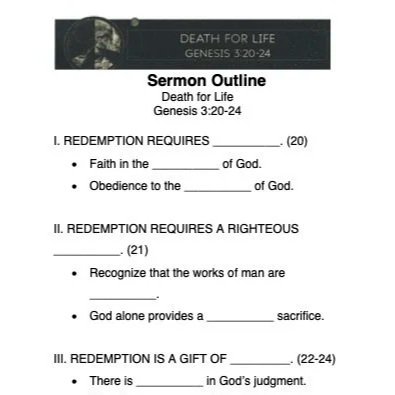
Enhance your sermon engagement with this comprehensive 3-page study resource and listening guide for "Death for Life" on Genesis 3:20-24.
Find Out More:
Additional podcasts, books, and downloadable PDFs of Pastor Ben’s sermon outlines and manuscripts are available at http://bensmithsr.org.
This sermon was originally preached on 10/12/2025.

Death for Life is a theologically rich sermon manuscript on Genesis 3:20-24 that declares the foundational truth of penal substitutionary atonement: redemption and new life do not come through ignoring or excusing sin but through death and the substitutionary sacrifice of a righteous offering. This exposition carefully unpacks how God's response to Adam and Eve's sin foreshadows the redemptive work of Christ and establishes the pattern for salvation throughout Scripture.
In Death for Life, discover how the first act of redemption in Genesis 3:20-24 reveals the heart of the gospel—life through death, grace through judgment, and redemption through substitution.
When Adam named his wife Eve, and God clothed the guilty pair with garments of sacrifice, He foreshadowed the ultimate redemption found in Christ’s atoning death. This sermon traces the doctrine of penal substitutionary atonement from Eden to Calvary.
Through clear exposition and pastoral insight, this sermon outlines three principles of true redemption:
Redemption requires faith (v. 20). The sermon explores the significance of Adam naming his wife Eve, meaning "life" or "life-giver." This section examines how this naming demonstrates Adam's belief in God's promise from Genesis 3:15 that a descendant of Eve would defeat the serpent. It connects Adam's faith to Abraham's, showing that believing faith—evidenced by obedience—has always been required for righteousness before God.
Redemption requires a righteous sacrifice (v. 21). This section reveals the insufficiency of human effort, symbolized by the fig leaf coverings Adam and Eve fashioned for themselves. The sermon demonstrates how God rejected their self-made garments and instead provided coverings of animal skin—requiring the first death in Scripture. It traces how this sacrifice foreshadows the Mosaic sacrificial system and ultimately points to Jesus, the once-for-all sacrifice who imputes His righteousness upon the redeemed.
Redemption is a gift of grace (vv. 22-24). The sermon concludes with the surprising grace found in God's judgment. This section explores why God expelled Adam and Eve from the garden, preventing access to the tree of life. It powerfully demonstrates that what appears harsh was actually merciful—had they eaten and lived forever in their fallen state, they would have remained eternally condemned. God's expulsion made true redemption possible through the death and resurrection of Christ.
Perfect for pastors, teachers, and students of Scripture, this resource provides detailed outlines, exegetical notes, and rich theological application. It also includes hymn reflections such as “In Christ Alone” and “My Hope Is Built on Nothing Less,” connecting biblical exposition with gospel-centered worship.
More sermon resources:





Church Bylaws and Parliamentary Consulting
Clear governing documents help a church carry out its ministry with consistency and care. When responsibilities are unclear, provisions no longer reflect present ministry, or meeting procedures are confusing, leaders can spend valuable time trying to determine what should happen next.
I help churches, associations, and nonprofit organizations examine their documents and address practical questions about how they conduct their work. Drawing on my pastoral leadership experience and work with church governing documents, I offer thoughtful review, parliamentary guidance, and written recommendations tailored to your organization’s needs and stated convictions.
How I can help
Review constitutions, bylaws, and policies for clarity, internal consistency, and practical ministry concerns.
Identify outdated provisions and discuss changes that support present ministry while respecting the organization’s beliefs and duly adopted rules.
Help committees organize a new document or revision project and develop proposed language within an agreed, permissible consulting scope.
Prepare meeting scripts for association moderators, church moderators, presidents, and chairpersons.
Help frame motions clearly and plan the parliamentary steps needed to consider them.
Assist clerks and meeting secretaries with preparing, submitting, and correcting minutes.
Research other parliamentary questions and explain recommendations in a written report.
Present findings to designated representatives or, by separate arrangement, to the full church or organization.
Begin with an initial consultation
The $75 initial consultation includes a 45-minute phone or video meeting and up to 15 minutes to review your intake answers and prepare a brief written next-step summary. We will discuss your needs, identify the relevant documents, and determine whether a focused service or a larger project is appropriate.
Detailed document review, substantive research, drafting, and presentations are quoted separately. You will receive the scope, fee, and anticipated schedule before additional work begins. Purchase starts the scheduling process; it does not reserve a particular appointment time. I will contact you within two business days to arrange our conversation.
About Ben Smith
I am a pastor with more than 25 years of pastoral leadership experience and a member of the National Association of Parliamentarians. My consulting focuses on practical ministry needs, clear documents, and orderly decision-making. I do not hold the Registered Parliamentarian credential.
This service provides ministry and parliamentary consulting, not legal advice or a legal compliance opinion. Legal drafting and questions about legal rights or obligations must be handled by qualified counsel. Your organization retains responsibility for its decisions and for adopting any proposed changes through the proper process.