

Genesis
Sermon Resources
Manuscripts | Outlines | Podcasts | Videos

A Comprehensive Study Through the Foundation of Scripture
Genesis 5–11 traces the spread of sin through the generations, God's grief over man’s wickedness, the judgment of the flood, the grace shown to Noah, God's covenant faithfulness, the Table of Nations, and the prideful rebellion at Babel. These chapters confront us with the depravity of man, the seriousness of judgment, and the unfailing faithfulness of God to preserve His redemptive promise.
Physical Format
This 294-page booklet is printed on 5.5 × 8.5-inch pages and bound with durable plastic comb binding (6.25 × 8.5 × 1 inches), making it easy to lay flat for study, teaching preparation, or note-taking. The convenient size fits perfectly in a Bible study bag or on your desk.
The manuscript collection includes eleven expository sermons from Genesis 4:25–11:32, each written to help believers understand the text, trust God’s promises, and live faithfully in a world marked by sin and rebellion.
Call On The Name of The Lord (Genesis 4:25–5:32) - Encouragement that God preserves His will and knows those who are His.
The Depravity of Man (Genesis 6:1–8) - Exposing the total corruption of man and the grace of God shown to Noah.
Trust and Obey (Genesis 6:9–22) - Considering Noah’s righteous obedience in response to the word of God.
Repent and Be Saved (Genesis 7) - Warning of God’s judgment and the only refuge found in salvation.
Great is Thy Faithfulness (Genesis 8:1–19) - Rejoicing that God remembers, preserves, and delivers His people.
Holy Worship (Genesis 8:20–22) - Examining Noah’s worship after the flood and the faithfulness of God’s promise.
Amazing Grace (Genesis 9:1–17) - Seeing God’s gracious covenant with Noah and His mercy toward the world.
Righteous Response to Sin (Genesis 9:18–29) - Learning how righteousness responds to sin with truth, sobriety, and faithfulness.
God of All Nations (Genesis 10) - Tracing the nations from Noah’s sons and seeing God’s sovereign rule over all peoples.
The Deadly Pride of Man (Genesis 11:1–9) - Warning against the prideful attempt to make a name apart from God.
Forever Faithful (Genesis 11:10–31) - Seeing the faithfulness of God as He preserves His redemptive promise from Shem to Abram.

A Comprehensive Study Through the Foundation of Scripture
Dive deep into the opening chapters of Genesis with this collection of 11 expository sermon manuscripts by Ben Smith, Sr. This resource provides both profound theological insight and practical application as it explores God's creation, man's nature, the curse of sin, and the foundation of redemption.
What's Inside
This 291-page volume contains complete sermon manuscripts and study materials covering:
God Created (Genesis 1) - Exploring God as creator, sovereign, and good
The Nature of Man (Genesis 1:26-31) - Understanding humanity as God's image bearers
Goodness of Work and Rest (Genesis 2:1-3) - Biblical foundations for labor and Sabbath
Breath of Life (Genesis 2:4-17) - Man's unique creation and purpose
Blessing of Marriage (Genesis 2:18-25) - God's design for the union of husband and wife
Fall of Man (Genesis 2:25-3:7) - How sin entered the world through deception
Curse of Sin (Genesis 3:8-19) - The devastating consequences of rebellion
Death for Life (Genesis 3:20-24) - The first glimpse of redemption through sacrifice
Right with God (Genesis 4:1-7) - What makes us acceptable before God
Sin's Ruinous Rule (Genesis 4:8-16) - The progression of sin without repentance
Purposeless Prosperity (Genesis 4:17-24) - The emptiness of worldly success without God
A Comprehensive Study Through the Foundation of Scripture.
Genesis 5–11 traces the spread of sin through the generations, God's grief over man’s wickedness, the judgment of the flood, the grace shown to Noah, God's covenant faithfulness, the Table of Nations, and the prideful rebellion at Babel. These chapters confront us with the depravity of man, the seriousness of judgment, and the unfailing faithfulness of God to preserve His redemptive promise.
What's Inside
This 294-page sermon manuscript collection includes eleven expository sermons from Genesis 4:25–11:32, each written to help believers understand the text, trust God’s promises, and live faithfully in a world marked by sin and rebellion.
Call On The Name of The Lord (Genesis 4:25–5:32) - Encouragement that God preserves His will and knows those who are His.
The Depravity of Man (Genesis 6:1–8) - Exposing the total corruption of man and the grace of God shown to Noah.
Trust and Obey (Genesis 6:9–22) - Considering Noah’s righteous obedience in response to the word of God.
Repent and Be Saved (Genesis 7) - Warning of God’s judgment and the only refuge found in salvation.
Great is Thy Faithfulness (Genesis 8:1–19) - Rejoicing that God remembers, preserves, and delivers His people.
Holy Worship (Genesis 8:20–22) - Examining Noah’s worship after the flood and the faithfulness of God’s promise.
Amazing Grace (Genesis 9:1–17) - Seeing God’s gracious covenant with Noah and His mercy toward the world.
Righteous Response to Sin (Genesis 9:18–29) - Learning how righteousness responds to sin with truth, sobriety, and faithfulness.
God of All Nations (Genesis 10) - Tracing the nations from Noah’s sons and seeing God’s sovereign rule over all peoples.
The Deadly Pride of Man (Genesis 11:1–9) - Warning against the prideful attempt to make a name apart from God.
Forever Faithful (Genesis 11:10–31) - Seeing the faithfulness of God as He preserves His redemptive promise from Shem to Abram.
A Comprehensive Study Through the Foundation of Scripture
Dive deep into the opening chapters of Genesis with this collection of 22 expository sermon manuscripts by Ben Smith, Sr. Volume 1 provides both profound theological insight and practical application as it explores God's creation, man's nature, the curse of sin, and the foundation of redemption. Volume 2 traces the spread of sin through the generations, God's grief over man’s wickedness, the judgment of the flood, the grace shown to Noah, God's covenant faithfulness, the Table of Nations, the prideful rebellion at Babel, and God's unfailing faithfulness in preserving His redemptive promise.

Sermon manuscript for expositionally preaching, teaching, or studying Genesis 1. The PDF includes the sermon manuscript, illustrations, and sermon outline handouts, along with reflection questions.
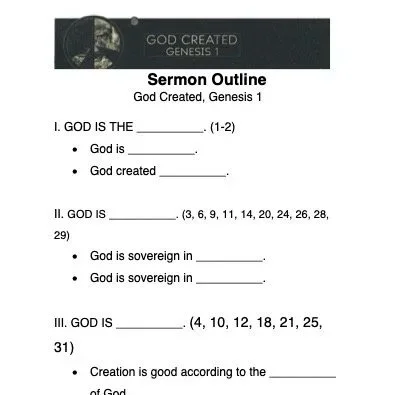
God Created - Sermon Outline & Listening Guide (Genesis 1)
Enhance your sermon engagement with this comprehensive 3-page study resource and listening guide for "God Created" on Genesis1.

Sermon manuscript for expositionally preaching, teaching, or studying Genesis 1:26-31. The PDF includes the sermon manuscript with illustrations, sermon outline handouts, and reflection questions.
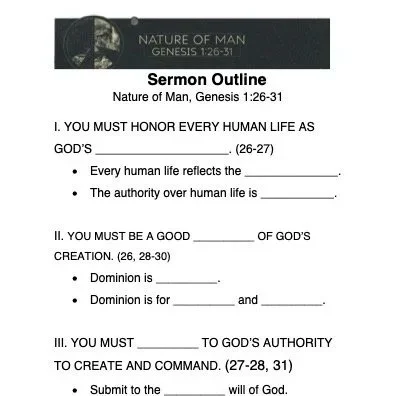
Nature of Man - Sermon Outline & Listening Guide (Genesis 1:26-31)
Enhance your sermon engagement with this comprehensive 3-page study resource and listening guide for "Nature of Man" on Genesis 1:26-31.
Sermon manuscript for expositionally preaching, teaching, or studying Genesis 2:1-3. The PDF includes the sermon manuscript with illustrations, sermon outline handouts, and reflection questions.
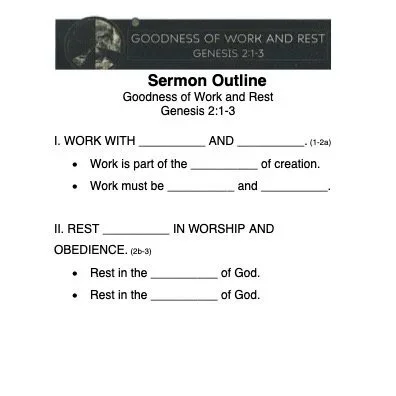
Goodness of Work and Rest - Sermon Outline & Listening Guide (Genesis 2:1-3)
Enhance your sermon engagement with this comprehensive 3-page study resource and listening guide for "Goodness of Work and Rest" on Genesis 2:1-3.

Sermon manuscript for expositionally preaching, teaching, or studying Genesis 2:4-17. The PDF includes the sermon manuscript with illustrations, sermon outline handouts, and reflection questions.
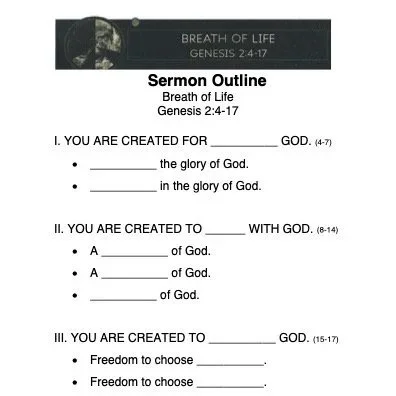
Breath of Life - Sermon Outline & Listening Guide (Genesis 2:4-17)
Enhance your sermon engagement with this comprehensive 3-page study resource and listening guide for "Breath of Life" on Genesis 2:4-17.

Blessing of Marriage – sermon manuscript and outline listening guide handout (Genesis 2:18–25)
PDF Download
What is the biblical foundation of marriage? In this expository sermon from Genesis 2:18–25, Pastor Ben Smith examines God's creation of Eve and the institution of marriage to reveal the divine design for the union between husband and wife.
Marriage is not a human construct, political opinion, or cultural norm—it is a good, exclusive, and holy union ordained by God at creation. Blessing of Marriage challenges believers to understand marriage as God defines it and to honor this foundational institution as the bedrock of family, church, and society.
Key Themes:
Understanding marriage as part of God's good creation, not man's invention
How husbands and wives are made for one another and intended to bless one another
Marriage as the first and most fundamental institution of society
The exclusive nature of the marriage covenant
The holiness of marriage before God and its protection from cultural attacks
Includes:
Full sermon pulpit notes (PDF)
Sermon outline handout
Reflection questions for personal devotion or group discussion
Format: Digital PDF
Length: 25 pages
Page Size: 6.5 x 8.5 in.
Scripture Text: Genesis 2:18–25
Series: Genesis
Author: Ben Smith, Sr.
Usage: For preaching, personal study, teaching, or ministry preparation (see copyright permissions included in the document)
Use this resource to preach, teach, or study the timeless truth:
This sermon resource provides biblical clarity on God's design for marriage, helping pastors, teachers, and individual believers understand marriage as a good, exclusive, and holy union. Ideal for premarital counseling, marriage seminars, or sermon preparation, these pulpit notes provide theological depth, practical application, and a robust defense of biblical marriage in a culture that increasingly redefines it.
Download includes:
✔️ Printable PDF format
✔️ Ready-to-preach sermon outline
✔️ Fill-in-the-blank outline handout
✔️ Reflection questions for spiritual growth and group discussion
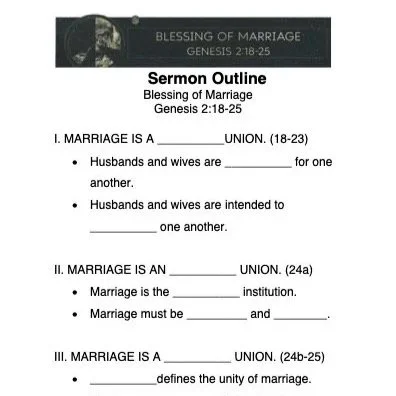
Blessing of Marriage - Sermon Outline & Listening Guide (Genesis 2:18-25)
Enhance your sermon engagement with this comprehensive 3-page study resource and listening guide for "Blessing of Marriage" on Genesis 2:18-25.

Fall of Man is a theologically rich sermon manuscript on Genesis 2:25-3:7 that exposes Satan's deceptive tactics and calls believers to trust fully in God. This exposition carefully unpacks how the serpent led Adam and Eve into rebellion through doubt, half-truths, and lies—and how the same temptations threaten believers today. The sermon points ultimately to Christ, whose redemptive work transforms and renews those who trust Him.
Formatted for 5.5 x 8.5 pages, this resource includes:
A full sermon manuscript in a clear, three-point outline format
A fillable outline listening guide handout ideal for congregations, small groups, or personal study
Reflection questions designed to deepen meditation and application through the week
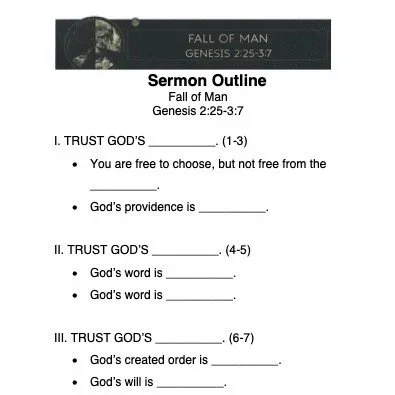
Fall of Man - Sermon Outline & Listening Guide (Genesis 2:25-3:7)
Enhance your sermon engagement with this comprehensive 3-page study resource and listening guide for "Fall of Man" on Genesis 2:25-3:7.

These downloadable sermon notes walk through Genesis 3:8-19, where God confronts Adam and Eve after the fall and announces the curse of sin. Pastor Ben Smith, Sr. unpacks the devastating effects of sin—how it breaks fellowship, cooperation, and purpose—while also pointing to the hope of redemption found in Christ.
Inside these notes, you’ll find:
A clear expositional sermon outline with main points and supporting Scripture
Exegetical insights into the text
Practical illustrations and applications
Reflection questions for personal or group study
Historical and theological references that enrich the message
Perfect for pastors, Bible teachers, and serious students of Scripture, these notes will deepen your understanding of sin’s consequences and magnify the glory of Christ’s redemption.
Format: PDF, instant download
Length: 27 pages
Page Size: Standard 8.5 x 11 in. (US Letter)
Author: Ben Smith, Sr.
Usage: For personal study, teaching, or ministry preparation (see copyright permissions included in the document).
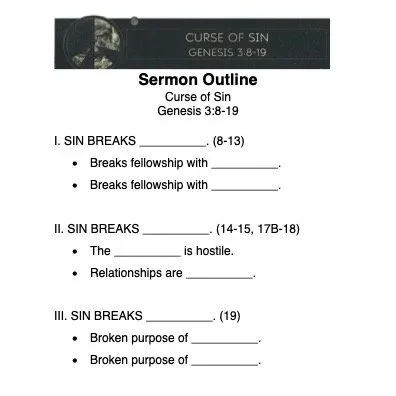
Enhance your sermon engagement with this comprehensive 3-page study resource and listening guide for "Curse of Sin" on Genesis 3:8-19.

Death for Life is a theologically rich sermon manuscript on Genesis 3:20-24 that declares the foundational truth of penal substitutionary atonement: redemption and new life do not come through ignoring or excusing sin but through death and the substitutionary sacrifice of a righteous offering. This exposition carefully unpacks how God's response to Adam and Eve's sin foreshadows the redemptive work of Christ and establishes the pattern for salvation throughout Scripture.
In Death for Life, discover how the first act of redemption in Genesis 3:20-24 reveals the heart of the gospel—life through death, grace through judgment, and redemption through substitution.
When Adam named his wife Eve, and God clothed the guilty pair with garments of sacrifice, He foreshadowed the ultimate redemption found in Christ’s atoning death. This sermon traces the doctrine of penal substitutionary atonement from Eden to Calvary.
Through clear exposition and pastoral insight, this sermon outlines three principles of true redemption:
Redemption requires faith (v. 20). The sermon explores the significance of Adam naming his wife Eve, meaning "life" or "life-giver." This section examines how this naming demonstrates Adam's belief in God's promise from Genesis 3:15 that a descendant of Eve would defeat the serpent. It connects Adam's faith to Abraham's, showing that believing faith—evidenced by obedience—has always been required for righteousness before God.
Redemption requires a righteous sacrifice (v. 21). This section reveals the insufficiency of human effort, symbolized by the fig leaf coverings Adam and Eve fashioned for themselves. The sermon demonstrates how God rejected their self-made garments and instead provided coverings of animal skin—requiring the first death in Scripture. It traces how this sacrifice foreshadows the Mosaic sacrificial system and ultimately points to Jesus, the once-for-all sacrifice who imputes His righteousness upon the redeemed.
Redemption is a gift of grace (vv. 22-24). The sermon concludes with the surprising grace found in God's judgment. This section explores why God expelled Adam and Eve from the garden, preventing access to the tree of life. It powerfully demonstrates that what appears harsh was actually merciful—had they eaten and lived forever in their fallen state, they would have remained eternally condemned. God's expulsion made true redemption possible through the death and resurrection of Christ.
Perfect for pastors, teachers, and students of Scripture, this resource provides detailed outlines, exegetical notes, and rich theological application. It also includes hymn reflections such as “In Christ Alone” and “My Hope Is Built on Nothing Less,” connecting biblical exposition with gospel-centered worship.
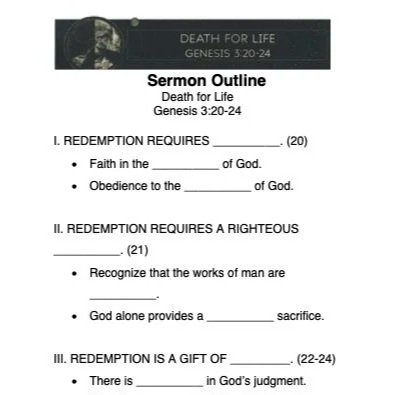
Enhance your sermon engagement with this comprehensive 3-page study resource and listening guide for "Death for Life" on Genesis 3:20-24.

What makes a person right with God? In this expository sermon from Genesis 4:1–7, Pastor Ben Smith explores the contrast between Cain and Abel’s offerings to show that being accepted by God requires submission to His Word—not the opinions or desires of man.
In a world that worships the autonomy of self, Right with God calls believers to reject self-made religion and return to true worship rooted in obedience, faith, and the atoning sacrifice of Jesus Christ. These pulpit notes expose how the idol of self corrupts your worship, relationships, and understanding of righteousness, and how only through Christ can you be made right with God.
Key Themes:
The danger of worshiping God on our own terms
Why only a worthy offering—one of obedience and atonement—is accepted
How submission to God’s will brings freedom from sin’s power
Includes:
Full sermon manuscript in outline format (PDF)
Sermon outline handout
Reflection questions for personal devotion or group discussion
Format: Digital PDF
Length: 24 pages
Page Size: 6.5 X 8.5 in. (Statement)
Scripture Text: Genesis 4:1-7
Series: Genesis
Author: Ben Smith, Sr.
Usage: For personal study, teaching, or ministry preparation (see copyright permissions included in the document).
Use this resource to preach, teach, or study the timeless truth:
Description:
This sermon resource unpacks three requirements for being accepted by God: giving a worthy offering, desiring to please God, and submitting to His will. Ideal for pastors, teachers, or individual study, these pulpit notes offer biblical depth, theological clarity, and practical application for today’s church.
Download includes:
✔️ Printable PDF format
✔️ Ready-to-preach sermon outline
✔️ Fill-in-the-blank outline handout
✔️ Reflection questions for spiritual growth and group discussion
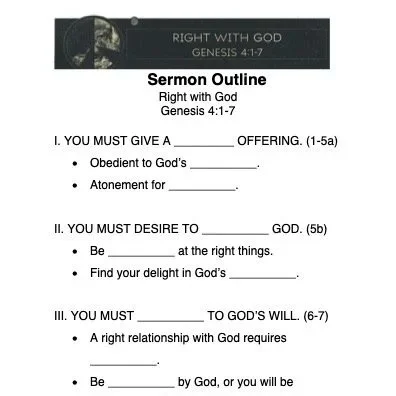
Enhance your sermon engagement with this comprehensive 3-page study resource and listening guide for "Right with God" on Genesis 4:1-7.

Sin’s Ruinous Rule – Semon manuscript and outline listening guide handouts (Genesis 4:8–16)
PDF Download
What happens when sin is left unchecked? In this expository sermon from Genesis 4:8–16, Pastor Ben Smith examines Cain’s tragic story to reveal the ruinous rule of sin and the devastating consequences of unrepentant rebellion against God.
In a world that often softens or excuses sin, Sin’s Ruinous Rule calls believers to confront sin honestly, respond to God’s conviction, and embrace repentance through faith in Jesus Christ. These pulpit notes explore the mastery of sin, spiritual blindness, and living under God’s judgment, offering biblical insight into how sin destroys relationships, hearts, and our fellowship with God when ignored.
Key Themes:
How sin gains mastery over the heart when unrepentant
Recognizing spiritual blindness and the danger of ignoring sin
Understanding God’s judgment and the hope of repentance in Christ
Includes:
Full sermon pulpit notes (PDF)
Sermon outline handout
Reflection questions for personal devotion or group discussion
Format: Digital PDF
Length: 27 pages
Page Size: 6.5 X 8.5 in.
Scripture Text: Genesis 4:8–16
Series: Genesis
Author: Ben Smith, Sr.
Usage: For personal study, teaching, or ministry preparation (see copyright permissions included in the document).
Use this resource to preach, teach, or study the timeless truth:
This sermon resource unpacks three warning signs of sin’s growing destruction—its mastery, spiritual blindness, and God’s judgment—while pointing to the hope and freedom found in repentance and faith in Christ. Ideal for pastors, teachers, or individual study, these pulpit notes provide biblical depth, theological clarity, and practical application for today’s church.
Download includes:
✔️ Printable PDF format
✔️ Ready-to-preach sermon outline
✔️ Fill-in-the-blank outline handout
✔️ Reflection questions for spiritual growth and group discussion
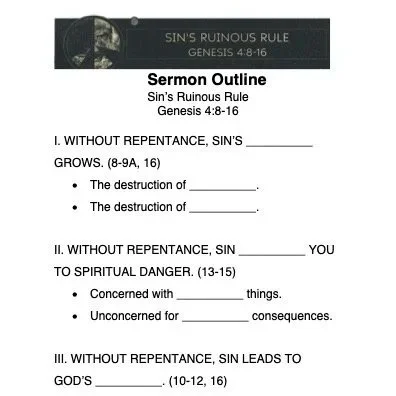
Enhance your sermon engagement with this comprehensive 3-page study resource and listening guide for "Sin’s Ruinous Rule" on Genesis 4:8-16.

Purposeless Prosperity – sermon manuscript and outline listening guide handout (Genesis 4:17–24)
PDF Download
What does it mean to prosper apart from God? In this expository sermon from Genesis 4:17–24, Pastor Ben Smith examines the story of Cain and his descendants to reveal the danger of success and achievement that lacks divine blessing.
Even impressive accomplishments—building cities, expanding families, or achieving worldly success—can be purposeless and empty when disconnected from God’s presence. Purposeless Prosperity challenges believers to recognize the distractions of busyness and foolish confidence and points them toward pursuing lasting purpose in Christ.
Key Themes:
How prosperity without God distracts from true spiritual priorities
The danger of busyness and achievements that build nothing eternal
Recognizing foolish confidence and reliance on human strength
Pursuing purpose and fulfillment in Christ alone
Includes:
Full sermon pulpit notes (PDF)
Sermon outline handout
Reflection questions for personal devotion or group discussion
Format: Digital PDF
Length: 21 pages
Page Size: 6.5 x 8.5 in.
Scripture Text: Genesis 4:17–24
Series: Genesis
Author: Ben Smith, Sr.
Usage: For personal study, teaching, or ministry preparation (see copyright permissions included in the document)
Use this resource to preach, teach, or study the timeless truth:
This sermon resource uncovers the emptiness of success without God, helping pastors, teachers, and individual believers examine worldly achievements, recognize spiritual distractions, and focus on lasting purpose in Christ. Ideal for study, teaching, or sermon preparation, these pulpit notes provide biblical insight, practical application, and theological clarity.
Download includes:
✔️ Printable PDF format
✔️ Ready-to-preach sermon outline
✔️ Fill-in-the-blank outline handout
✔️ Reflection questions for spiritual growth and group discussion
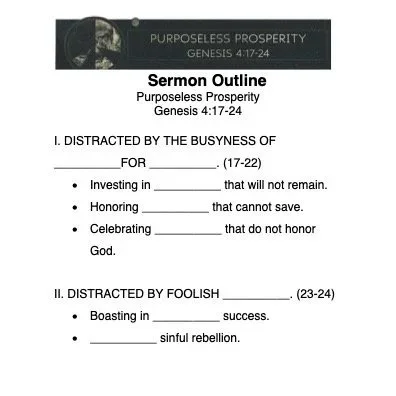
Enhance your sermon engagement with this comprehensive 3-page study resource and listening guide for "Purposeless Prosperity" on Genesis 4:17-24.

In a world where rebellion seems to multiply and faithfulness feels increasingly rare, Genesis 4–5 offers a steadying word of hope: God has never depended on the crowds to accomplish His purposes. He preserves a remnant, knows His people by name, and faithfully advances His redemptive plan.
Call On the Name of the Lord is a full expository sermon manuscript that walks through Genesis 4:25–5:32, contrasting the way of Cain with the faithful line of Seth. While Cain’s descendants boast cultural achievement and numerical growth, Seth’s line is marked by something far more enduring—they call upon the name of the Lord. This sermon encourages believers living in discouraging days by anchoring their hope in God’s sovereignty, promise-keeping, and intimate knowledge of His people.
Drawing connections from the antediluvian world to later moments in church history—and ultimately to the present—the sermon reminds readers that God’s work is never threatened by widespread unbelief. From Adam to Noah, from underground churches to today, God has always preserved His own.
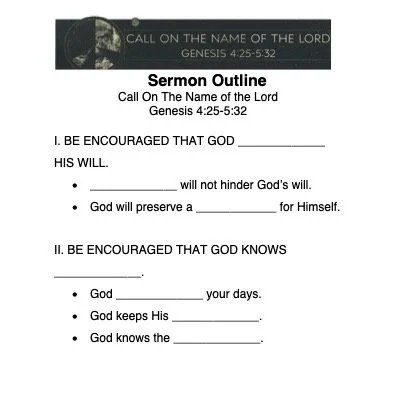
Enhance your sermon engagement with this comprehensive 3-page study resource and listening guide for "Call On The Name Of The Lord" on Genesis 4:25-5:32.
In an age where sin is normalized and wickedness often celebrated, Genesis 6 reminds us that our day is not unique—and that God has never been blind to human rebellion nor absent in His grace. The Depravity of Man is a clear, sobering, and hope-filled exposition of Genesis 6:1–8 that confronts the reality of human sin while magnifying the initiating, undeserved grace of God.
This sermon traces the rapid moral collapse of humanity from Adam to Noah, setting our present cultural moment in biblical perspective. While many are tempted to believe that today’s wickedness is unprecedented, Scripture reveals that the antediluvian world was marked by near-universal rebellion—yet even then, God preserved a righteous witness and extended saving grace. The result is a timely call for Christians to live righteously, preach faithfully, and rejoice deeply in grace.
All For the Kingdom Sermon Podcast

Naomi returned to Bethlehem believing that suffering had left her empty, but God was already working through her loss to accomplish purposes she could not yet see. Ruth trusted the sovereignty of God and remained faithful even though she did not know what awaited her.
Faith does not require us to understand everything God is doing. It calls us to turn toward Him in suffering, obey His Word, and remain faithful because He is always faithful.

False accusations can awaken a powerful desire to defend ourselves before everyone who will listen. Psalm 7 directs us first to a better court: the presence of the God who knows every heart, sees every hidden truth, and judges with perfect righteousness. David does not pretend to be sinless, but he can place his innocence concerning the charge before the Lord.
When your name is attacked, examine yourself honestly, repent where repentance is needed, and then rest in God’s verdict rather than living for human approval. The judgment of the world cannot give lasting peace, but through Jesus Christ there is grace, forgiveness, and peace with God. Because evil will not have the final word, God’s people can live without fear.

Psalm 6 gives words for believers who are weary, troubled, and overwhelmed. David does not hide his distress, but he brings it before the Lord and pleads for mercy.
This sermon calls us to run toward God in seasons of sorrow, not away from Him. Hope comes not from a change in circumstances, but from the assurance that the Lord hears, receives our prayer, and shows mercy to His people.

Psalm 5 contrasts the holiness of God with the wickedness of the world. David begins the day in prayer, rejoicing that God hears His people and recognizing that entrance into God’s presence comes only by His abundant lovingkindness.
This sermon calls believers to live righteously in an unrighteous world. Do not envy the world, imitate the world, or join the world in rebellion. Walk before the Lord in holiness and trust the shelter of His favor.

Psalm 4 teaches us how to respond when lies, slander, and reproach threaten to define us. David turns to the Lord and remembers that the world may tell lies and believe lies, but God knows the truth perfectly.
This sermon calls believers to find their worth in the Lord, declare what is true, and trust God’s deliverance. Because the Lord hears His people and makes them dwell in safety, they can lie down and sleep in peace.

Psalm 3 was written when David fled from Absalom. His enemies had increased, many had turned against him, and some declared that there was no deliverance for him in God.
This sermon reminds us that peace is not found in the absence of threats, but in the presence and power of God. The Lord is our shield, our glory, and the One who lifts our head. Salvation belongs to the Lord.

Psalm 2 declares that the nations may rage and the rulers of the earth may rebel, but God is not threatened. He has installed His King, and all creation is moving toward the exaltation and glory of Jesus.
This sermon calls us to submit to King Jesus, honor Him, worship with reverence, and take refuge in Him. Blessed are all who take refuge in the Son
Psalm 1 sets before us two ways: the way of the righteous and the way of the wicked. The world offers counsel that seems safe and promising, but worldly wisdom will not stand before the judgment of God.
This sermon calls us to delight in the law of the Lord, meditate on His Word, and walk in the way of righteousness. True blessedness is found not in chasing happiness, but in knowing and delighting in God.

Jesus sent the seventy to proclaim that the kingdom of God had come near. The harvest was plentiful, but the laborers were few.
This sermon from Luke 10:1–16 calls believers to preach the kingdom, endure hardship, and serve the King with surrendered lives. The message remains unchanged: Jesus is Lord, salvation is in Him alone, and all people must come and worship the King.

Jesus gives sobering warnings in Mark 9:38–50. Do not hinder those whom God is using. Do not cause little ones to stumble. Do not let anything in this world draw you into sin.
This sermon considers the seriousness of sin, the reality of hell, and the call for God’s people to live as salt in the world.

In the parable of the two sons, Jesus exposes the danger of saying the right thing while refusing to obey. The issue is not religious appearance, but whether the heart is truly submitted to God.
This sermon from Matthew 21:28–32 calls sinners away from empty words and toward faithful obedience to the King.

The disciples wanted to know who would be greatest in the kingdom of heaven. Jesus answered by placing a child before them and teaching that unless they turned and became like children, they would never enter the kingdom.
This sermon from Matthew 18:1–4 considers the necessity of humble repentance. Before asking who is great in the kingdom, every sinner must ask whether he has entered the kingdom through Christ.

Jesus commands His people to seek first the kingdom of God and His righteousness. In a world filled with anxiety, earthly priorities, and kingdoms of our own making, Matthew 6:33 calls us to reorder our hearts under the rule of God.
This sermon considers how seeking the kingdom first redirects our attention, shapes our pursuit of righteousness, and teaches us to trust the Father’s provision.

Jesus did not come to abolish the Law and the Prophets, but to fulfill them. In Matthew 5:17–20, Jesus teaches that God’s kingdom, God’s Word, and God’s righteous standard stand forever.
This sermon considers the perfection required to enter the kingdom of heaven and the good news that Jesus fulfills the law’s demands for all who are saved by Him.

When Jesus began to preach, His message was clear: “Repent, for the kingdom of heaven is at hand.” The coming of the kingdom is good news, but it is also a summons. The King has come, and sinners are called to turn from sin and self and submit to His righteous rule.
This sermon from Matthew 4:17 considers repentance as a word of confrontation, action, and truth. The warning is urgent, the way of salvation is singular, and the hope of the gospel remains: repent and be saved.

In 2 Kings 2:1–19, Elijah’s ministry comes to an end and Elisha’s begins. Yet the work of God does not end with Elijah. The Lord is eternal, His Word remains unchanged, and His kingdom continues from one generation to the next.
This sermon calls the church to prepare faithfully for endings and beginnings. All men come to an end, each generation must invest in the next, and God’s people must affirm faithful calling and service for the ongoing witness of the gospel.

When Ahab took possession of Naboth’s vineyard, he may have thought the matter was settled. But God saw the murder, the theft, the excuses, and the rebellion. The Lord sent Elijah to speak plainly: Ahab had murdered and taken possession.
In this sermon from 1 Kings 21:17–29, Ben Smith shows why God’s people must be faithful to speak truth in every season. Biblical confrontation is not rooted in anger or malice, but in love, compassion, and the desire that sinners would repent and be restored to the Lord.

After revival on Mount Carmel came fear, threats, and discouragement. In 1 Kings 19, Elijah fled from Jezebel and momentarily lost sight of the God whose power he had just witnessed.
This message reminds us that the hostility of the world is real, but God remains sovereign, present, and faithful. When the threats of this world shake us, we must remember that God is bigger than our fears and greater than our perspective.

Genesis 11:10–32 records the genealogy from Shem to Abram, but this passage is far more than a list of names. It is a testimony that God is faithfully preserving His word and accomplishing His redemptive plan, even when the world is marked by rebellion, corruption, and idolatry.
This sermon encourages believers to trust the Lord’s faithfulness throughout history, despite man’s corruption, and according to His enduring word. God has been faithful, God is faithful, and God will forever be faithful.

The Tower of Babel is more than a childhood story about a tall tower and confused languages. Genesis 11:1–9 reveals the deadly pride of man: the desire to make a name for ourselves, live apart from dependence on God, and assert our will over His.
In this sermon, Ben Smith, Sr. examines the pride of ability, the pride of self-sufficiency, and the pride of mastery, calling believers to reject the illusion of independence and humble themselves before the sovereign God.

Genesis 10 may seem like a chapter that can be passed over quickly, but it bears profound witness to the sovereignty of God. The nations of the earth are neither random nor outside His rule. Behind every family line, every people group, and every generation stands the God who created all things and governs history according to His will.
In “God of All Nations,” we are reminded that human power is fleeting, but God’s purposes never fail. The same God who governed the nations in Genesis is still accomplishing His redemptive will today, and in Christ He has made salvation known to people from every tribe, tongue, and nation.

We live in a world where truth is often overshadowed by personal belief and cultural pressure. In 1 Kings 18, Elijah confronts that confusion head-on, calling God’s people to stop wavering and to recognize the one true God.
Through the dramatic events on Mount Carmel, this sermon reminds us that sincerity cannot make lies true, and that when God reveals Himself, we are called to respond with repentance, obedience, and faithful worship.

When the world appears strong and the church appears weak, it can be difficult to see how God is working. Yet Scripture reminds us that what looks like defeat is often the very place of God’s victory.
In this message from 1 Peter 3:18–22, we are called to fix our eyes on the risen Christ. His suffering accomplished our salvation, His proclamation declared His triumph, and His resurrection assures us that He reigns now and forever.
What does it mean to be ransomed by God? In 1 Peter 1:17–21, we are reminded that our redemption was not purchased with silver or gold, but with the precious blood of Christ. This truth reshapes how we live, how we hope, and how we approach God.
Because the ransom has been paid, believers can live with confidence—not in themselves, but in the finished work of Christ, the eternal will of God, and the hope secured through the resurrection.
How you respond to sin reveals your heart toward God. Genesis 9:18–29 shows that even the most faithful can fall, but the greater issue is how we respond when sin is exposed.
This sermon calls believers to recognize the danger and shame of sin while resting in the grace that sustains and preserves God’s people.

After the flood, God spoke to Noah and established a covenant that would shape the future of the world. In Genesis 9:1–17, God reveals His grace through the fulfillment of His eternal will, the provision of His law, and the patience of His covenant promise.
Even in a world still corrupted by sin, the rainbow stands as a reminder that God’s grace continues to restrain judgment and provide hope.

When the truth of God confronts us, it always demands a response. We will either be troubled by it or transformed by it. In 1 Kings 18, Ahab blames Elijah for Israel’s suffering, yet the real problem is his own rebellion against God.
This sermon calls you to examine your heart and choose: will you resist the truth, or will you stand firmly on it, even when it costs you?

Noah stepped off the ark into a changed world marked by judgment and grace. His first act was worship—an altar built to the God who saves. Genesis 8:20–22 shows that true worship arises when we remember God, acknowledge our sin, and rest in His sovereign grace. This message calls believers to offer their lives wholly to Him.

In Genesis 8, Noah spends more than a year in the ark with no visible sign that life will ever return to normal. Yet Scripture shows us that even when God seems silent, He is never absent. God remembers His people, encourages them with signs of His grace, and speaks His word to declare new beginnings. This message invites believers to trust the unwavering faithfulness of God in every season.
The ark stood as both hope and warning. Repent and believe while the door of grace remains open.
Ponderings

The 2026 Southern Baptist Convention Annual Meeting in Orlando generated no shortage of commentary, but much of what is said about the SBC is difficult to understand apart from Baptist polity, parliamentary procedure, and the purpose of an annual meeting. The SBC is not a church with authority over local congregations, but a voluntary association of autonomous churches that cooperate together for the sake of gospel work.
In these reflections, I consider what took place in Orlando, why theological and doctrinal clarity remains both healthy and costly, and why the slow deliberation of the SBC should not necessarily discourage us. Though there is energetic debate among Southern Baptists, there are also encouraging signs of faithfulness, seriousness, and renewed attention to biblical ecclesiology.

After fourteen years of ministry at my church in Waycross, Georgia, my ministry as pastor has come to an end. The central issue was not merely personal disagreement, but a matter of conviction concerning the Lord’s Supper, the church covenant, and the responsibility of the church to administer the ordinances faithfully.
This reflection seeks to explain the issue with pastoral clarity, theological conviction, and trust in the providence of God. Though this is not how I would have written the story, I remain confident that the Lord is good, His purposes are wise, and every offering made to Him is never wasted.

Last week, the Southern Baptist Convention held its Annual Meeting. Gathered in New Orleans, LA, nearly 19,000 attended. Of these, 12,737 were registered messengers (similar to delegates) from 4,423 churches. Over the two days of meetings, the messengers worked through a packed schedule that included changes to the Convention's doctrinal statement and a constitutional amendment, among other things. Southern Baptists are unique in that we debate critical issues publicly, with any registered messenger able to speak. This does not always make for flattering soundbites in the news and sometimes leads outside observers to think that we are contentious and in constant conflict. For those who attend the meetings and participate in the decisions, even in greatly debated issues, we generally depart the annual meeting more encouraged in the work and cooperation of the SBC. Below are some of the more significant decisions of the messengers to this year’s annual meeting.

One of the occupational hazards of being a pastor is sometimes your words come back to you. Pastors talk a lot. Pastors often give counsel. Pastors instruct, teach, and preach. With all this talking, there are many directives and admonitions given. And so, it is not uncommon for someone to start a conversation with me with the words, “Pastor, you said.”
In the past week, this has happened twice. One was a comment made without recognizing that they were rebuking me, and the other was a direct and clear corrective word. Both were received as precious blessings and profound encouragements.

Last night my church gathered for communion and a meal. It was an especially sweet time of fellowship as we gave attention to the cost and sacrifice paid for our sin. I was struck by the contradictory emotions of the evening. We grieved that it was our sin that Jesus suffered and died for, and yet we rejoiced that He gave such a sacrifice that we might live. We rejoiced in the precious gift of forgiven sin and eternal life, yet we grieved over those we know and love who remain under the wrath of God. We found great comfort in our kinship in Jesus, yet we longed for others to join us at the table. I was reminded that the cross is both a testimony of grief and joy for Christians.

This Sunday is Palm Sunday, the day we remember the triumphal entry of Jesus into Jerusalem. The crowd excitedly welcomed him because they hoped he was a king like the rulers of man. But Jesus was not coming to Jerusalem to topple Rome; He was coming to destroy death. He was not arriving to respond to political grievances but to satisfy the wrath of God. He was not coming to comfort us with platitudes but to confront our sin on the cross with His own body and blood.

It may be that the most important element of effective communication is repetition, even while it is the most unappreciated. We tend to arrogantly claim that we only need to hear things once. When a parent repeats an instruction, children roll their eyes. When a boss repeats a familiar command, employees complain that it is superfluous. When a teacher reviews material already taught, students complain they already know the material. We tend to believe we can receive information or commands and never again need a reminder or renewed encouragement.

Swearing is everywhere — in public spaces, media, and everyday conversation. What does our language reveal about our hearts and our faith? This post explores how the rise of vulgar speech reflects deeper spiritual realities, challenges assumptions about righteousness, and points us toward genuine transformation through Jesus Christ.

A racquetball game gone wrong left a congregant with a black eye—and taught me an unforgettable lesson on preparedness, Ephesians 6, and the Armor of God.

I recently read that the average length of service for pastors in Protestant churches in America is about four years. If accurate, it makes sense why so much of the advice to pastors concerning church leadership seems to be directed to the early years of ministry. From seminary professors to denominational leaders, I have often heard encouragements to pursue a long pastoral tenure. These encouragements often included descriptions of the benefits that come from long tenures. In last week's blog post, I wrote on eight blessings I have experienced after pastoring in Waycross for over ten years. But I have also discovered that having pastored here for more than a decade has brought some burdens. Here are three burdens that have come from pastoring for over ten years.

A successful pastorate is as much dependent on the church as it is on the pastor. Since 2012, I have been privileged to pastor in Waycross, GA. There have been seasons of great joy and great sorrow, but there has not been a day I was not thankful for this fellowship. Recently, I have been reflecting on how pastoral ministry differs once you pass the 10-year point. Below are my observations of eight blessings that have come from pastoring a church over ten years.

The first Christmas of the war came five months after the war began. As soldiers sat in their wet and muddy trenches, they anticipated that Christmas day would come and go as so many days before had been spent. However, as darkness fell over the battlefield on Christmas Eve, British soldiers began to hear singing. The German soldiers were singing Christmas carols. The British soldiers heard familiar melodies emanating across the battle-scarred earth where so many had died, and some corpses still lay where they fell. They listened. Some even added their voice to the strange choir. Singing would lead to invitations, and miraculously the soldiers eventually climbed out of their muddy holes and met one another in "No Man's Land," to celebrate Christmas together. There were handshakes, sharing of cigarettes and cigars, and most importantly, a momentary pause in the exchange of gunfire. Diaries and letters to loved ones back home told of makeshift Christmas trees being erected and decorated, soccer games, and other joint activities in stark contrast to the context and location. The momentary relief from the prosecution of war also allowed both sides to collect their dead.

One of the common experiences of growing up in a Baptist church in the south was hearing preachers tell stories of their recent evangelistic conversations. The stories would generally begin with the preacher telling how he met someone in a restaurant or on a plane. The stories tended to have similar arcs. They would begin by describing the other person as someone the preacher was unlikely to run into in their daily activities. The conversation was begun with an intriguing question and eventually ended with the person praying to receive Christ as their savior. At their best, these stories were intended to encourage the church to take every opportunity to share Jesus wherever they went and with whomever they encountered. At their worst, these stories were thinly veiled boasts of spiritual greatness and had the effect of creating the feeling of inferiority and ineptitude in those listening in the pews. I genuinely believe the stories were true, yet I suspect the presentation was skewed. Skewed, in that, intended or not, the way these stories were told seemed to communicate that every conversation the preacher had ended in a successful conversion story. I doubt that was the reality for the preachers of my youth, and it has certainly not been true for me in my experience.
I do try to take every opportunity to share Jesus wherever I go and with whomever I encounter. This has indeed led to unexpected opportunities to share Jesus with strangers. And I have experienced great joy when these encounters have led to someone confessing in faith Jesus as their Lord. But the truth is that most of these encounters have not ended in a sermon illustration-worthy confession of faith but rather a rejection of my plea to come and know Jesus. What follows is the account of just such an encounter and how it has changed how I think about evangelism.

The spoken word is powerful. There is power in speaking a name. There is power in speaking a declarative statement. There is power in asking a question. God created man with the ability to formulate and express thoughts with words. We know God through His word, and we express ourselves to God through words in prayer. Our relationship with one another is developed by the words that we speak. The spoken word can be glorious in that it can encourage, inform, bring joy, and heal. The spoken word can also be destructive in that it can discourage, deceive, and wound. With our words, we can enlighten or confuse, bless or curse, build up or tear down, encourage or demoralize.
The ability to express thoughts and emotions through speech is part of being made in the image of God. God is one who speaks. God spoke all things into existence. The third verse of the Bible begins with the words, “and God said.” With these words, God declared what was good and pleasing. Later God gave testimony to Himself through the words of the law. And finally, Hebrews tells us, “Long ago, at many times and in many ways, God spoke to our fathers by the prophets, but in these last days he has spoken to us by his Son, whom he appointed the heir of all things, through whom also he created the world.” And our God who speaks, by His command, created man in His image with the glorious gift of expressive speech.

This past week about 11.4 million people in the U.S. and 32.5 million in Britain tuned in to watch the funeral services of Queen Elizabeth II. There was much in the ceremony that was connected to the symbols and trappings of royalty but what I found most encouraging was how much scripture was read throughout the proceedings.
I had a college professor who often encouraged junior classmen to attend graduation ceremonies even if they had no personal connection with graduates. He reasoned that attending the ceremony of those who had completed their studies would be a need encouragement to those who were still pursuing their degree. Freshmen enjoy the enthusiasm associated with starting something new. Sophomores are still working through the basic core classes. Juniors are working through the more rigorous classes in their chosen major. They no longer have the excitement of freshmen, and they may not yet have the clarity of purpose of seniors. Attending the commencement ceremonies helps give clarity to the purpose and goal of their academic pursuits. In a grander way, funerals help to provide clarity to the pursuit and goal of our lives. Funerals can be stressful and emotionally difficult, but I think they are important to the church's witness.

I like consistency. I run the same route every day for my morning run. I know the exact places on the course where I will hit distance goals. I know the houses where there are dogs and which ones bark, which ones will come out to meet me, and which ones just watch me run by. I know where the pavement is uneven and where it is smooth. The consistency of running the same route and learning all these details allows me to give little attention to where I am and where I am going. It allows me the freedom to just enjoy the run because the details of the route, distance, and road hazards are so well known they require little notice.
The familiarity provided by consistency also allows me to focus on other things. I have employed prayer prompts for many years to remind me to pray for certain things. Prayer prompts are places and things that remind you to pray for a specific need when you see them or pass them by. Once, a pastor asked me to pray for an issue his family was facing. So, every morning when I ran past his home, I prayed for him and his family. Over the years, the specifics of what I pray as changed. But every morning, as I run down his road, I still pray for him, his family, and his church.

There are two opposing kinds of workers. The first kind often looks like they are not giving much effort to their work. They get their job done and are good at what they do, but because of the appearance of the lack of effort, some judge their job as easy in comparison to others. The second kind often looks overworked, overstressed, and working very hard. They, too, get their job done, but because of the effort and stress required, many judge their job as more burdensome than others.

This summer, my parents celebrated their 50th wedding anniversary. My sister Abbie, and I, along with our spouses and children, traveled to Columbus for the celebration. Everything about the weekend was joyful and good. On Saturday night we enjoyed a meal together with all the family. Afterward, we gathered at the house and played a video for my parents of good wishes from many of their friends. On Sunday, I had the privilege of teaching my dad's Sunday school class; then, we packed a pew for Sunday worship. After church, we took lots of family pictures. Every moment of the weekend was joy-filled.
During the weekend I looked at my parents' wedding photos. In the pictures, they are young, fresh-faced, and smiling. Though it is hard to think of your parents as being other than how you have known them, I know enough to know that the young couple in the photos had no clue what the years ahead would bring. In the photos, they are all smiles and youthful glee. Their faces show no signs of worry, and their smiles look genuinely carefree. There is one particular photo that captured my attention. It was the photo of the moment my parents emerged from the church to leave for their honeymoon. All the wedding guests had lined up beside the door to wish them well as they ran to the car. It was the tradition then to throw rice at departing couples, but because my dad worked for a peanut company, the guests through peanuts. The photo captures the moment of glee just after the covenant making and before the covenant keeping. Peanuts are in the air. Their smiles seem more part of who they are than momentary expressions as they dodge the flying legumes. They were husband and wife, happy to be united in marriage and excited to begin their life together. The photo perfectly captures that most joyful moment.

Therapy is painful—but I keep returning. Each session pushes my wrist to its limits, leaving me squirming and struggling to endure the sharpest pain. Yet I trust my therapist’s skill and purpose. Pain, though excruciating, becomes the pathway to healing, restoration, and eventual joy. Choosing discomfort may seem counterintuitive, but the results make it worth every moment.

Cell service in my office is spotty, and my calls are often dropped. Sometimes when this happens, I am unaware until I end a sentence and wait for the other person to respond and only hear silence. Not sure if they are in thought, still waiting on me to say something else, or no longer on the line, I ask, "are you still there"? I know that I have been talking to myself when this question is met with more silence.
You may have been wondering if I am still here. It has been over a month since I have written a blog post or sent out an email. My lack of activity has not been for lack of desire but rather circumstances not entirely of my choosing.

Next week, the Southern Baptist Convention will hold our Annual Meeting. On Tuesday and Wednesday, thousands of Southern Baptists will gather in Anaheim, California, to make decisions concerning the direction of the denomination. To the outside observer, the Annual Meeting of the SBC is often misunderstood. The SBC is unlike other denominations that are governed through hierarchical authority. The SBC is comprised of over 47,000 autonomous churches that have cooperated to advance global and North American missions, theological education, and other related ministries. We voluntarily associate and are bound together by our cooperative support of missions and our adherence to the Baptist Faith and Message 2000, which is our doctrinal statement.
Each cooperating church can send messengers (similar to a delegate) to the Annual Meeting. The ultimate authority and control of the convention rest with the messengers. There are many advantages to this governance structure, not the least of which is that the messengers can act contrary to the denominational leadership when corrective action is needed. However, the messenger model also means that our disagreements, deliberations, and discussions are all done publicly. In a world where many get their news from social media, these open debates often overshadow the actual final decision of the messengers.

Meeting Mac Brunson at the St. Louis Arch was… awkward. This brief, embarrassing encounter became a family story—and a reminder of how much time, patience, and perspective are needed to truly communicate. In this post, I unpack the humor, the discomfort, and the surprising lessons that come from “meeting” Mac Brunson.

This past Sunday, the Southern Baptist Convention's Sexual Abuse Task Force released the report of Guidepost Solutions, which performed an independent investigation on issues related to sexual abuse and how the SBC's Executive Committee members and staff have responded to sexual abuse issues. Since the report's release, there have been many news reports; however, because secular media generally does not understand what the SBC is or how it is governed, it often misunderstands and thus misreports events related to the SBC. Add to this a general distrusts of secular media because of their hostile bias toward Christians many have struggled to understand the actual impact and ramifications of Guidestone's report. The report is 288 pages and includes two appendices that are 73 and 106 pages, respectively. Because of its size and complexity, many are relying on secondary sources to inform them about the report's findings and conclusions.
I have read the report, and I intend to give my initial thoughts on it in this post. I am sure that as additional time provides an opportunity to further appreciate the gravity of what is revealed and more thoughtfully understand how Southern Baptists should respond to it, there will be more to say.

I felt a sadness as I explored the three church buildings of Cades Cove. I felt a longing for what was and grieved for what would never be again. Each building retains the same beauty of its construction and ornamentation as they held before their congregations moved away. Though lacking modern accoutrements, all three church buildings have been well maintained and still house the accommodations and furniture employed by their former members. Unfortunately, they are today essentially museum exhibits, preserved for observation but not for use. This designation was a source of sadness and grief for me as I walked through these empty church buildings.
The architecture of church buildings often is designed for beauty, but esthetics is not the primary concern for the design of a church building. Church buildings may be beautiful, but they are not constructed singularly for esthetics but primarily for action. The three church buildings of Cades Cove are functional in form and simplistic in nature, built for ministry. While it is true that more sophisticated and moneyed congregations have built more elaborate and ornate structures than those that grace Cades Cove, they too are mostly functional in their architecture. Whether it be for preaching, teaching, or meeting a need in the community, church buildings are designed to support the church's ministry. And it is ministry that is at the heart of a church's existence.

Outside of each church building are small cemeteries. The tombstones are a lasting witness of those who worshiped in each congregation. These gardens of the dead have their own stories to tell about the congregations that worshiped in these buildings. Common surnames top many of the stone markers telling of prominent families in each church. Dates of birth and death are chiseled into each grave marker giving witness to the world that the occupant knew at birth, the events of history they knew in life, and the plenty or scarcity of the number of their days at death. Though most markers give up few secrets other than the most basic biographical information about the person that lies beneath, some speak, though cryptically, a more elaborate witness. Historians tell us that the residents of Cades Cove were greatly divided in their loyalties during the Civil War. The festering disunity in the congregations was so great that the churches chose not to hold services for long periods during the war. One grave marker leaves no doubt about the loyalties of the one buried beneath by declaring that rebels in North Carolina murdered its occupant. Other graves are remarkable simply because of their age. This is particularly true for the graves of those who fought in the Revolutionary War. Yet these realities are expected. These churches are old; thus, so are the inhabitants of their cemeteries. Though remarkable, it is expected to find graves of those who died long ago. However, what I did not expect to find in these old cemeteries beside abandoned church buildings were modern grave markers. The congregations that built these buildings and buried their dead in these cemeteries have long since disbanded, but I discovered in the freshly turned dirt and slabs of marble not yet stained by the abuse of weather that their legacy remains.

These buildings were constructed with one purpose in mind – preaching. Preaching is a relatively simple activity. It is singular in focus and defined in its goal. The very structure of these buildings gives testimony to the singular focus and defined goals of their congregations. The proclamation of the Word of God was their aim. There is something refreshing about such simplicity. For those who worshiped in these structures, church meetings were a time to hear the Word proclaimed. They certainly sang hymns together. They prayed together and for one another. However, the primary focus and the defining element of their gatherings was preaching. The architecture of these buildings gives witness to this singular focus. The buildings were built to provide a place for preaching. The furniture is arranged to facilitate preaching. These congregations certainly participated in other activities associated with their ministries, but the testimony of the buildings is that their primary activity was preaching God’s word.
The problem with nostalgic thoughts is they are but sentimental imaginations, not necessarily accurate recollections. These places of worship are simplistic, yes – but perfect, no. There is value in simplicity, yet there is also foolishness in holding to the past out of nostalgia alone. I am thankful that my church in South Georgia, where humidity, heat, and gnats create a summer environment that can wilt a rock, has air-conditioned buildings. With the blessing of air-conditioning comes related aggravations, but these are considered small compared to the unpleasantness of enduring south Georgia’s oppressive heat and humidity.

Several years ago, I played the role of tourist while staying in the smoky mountains of southern Tennessee. We loaded the kids in the van, got out our area attractions map, and headed to a nearby national park called Cades Cove. It was a simple affair. A cove nestled in the bosom of mist-shrouded mountains. A pastoral valley cleared and tamed as the first settlers of European descent arrived some 200 plus years ago. It remained the home of the first settlers and their descendants until the 1930s, when the U.S. government acquired it for a national park. Today it remains not dissimilar from what it was in the 1930s. A potted and bumpy paved road now traverses what was once a potted and bumpy dirt road that encircles the valley.
Today, only a few cabins and farm buildings remain. These structures no longer have a purpose as part of working farms but now are preserved as museum pieces. What once was a place where life was hard and laborious is now a scenic drive full of valley vistas and remarkable sightings of turkey, deer, and other wildlife that have grown accustomed to the slow-moving vehicles with their staring faces and clicking cameras. And yet they do remain. The cabins still show the hewing marks of their builders and original owners. The barns, still holding hollowed logs, worn smooth from their former duty of offering the grain and straw to hungry livestock. The cabins, mills, smokehouses, and barns, the plows, wagons, and planters warn and seasoned with use and age still look as though they could return to duty at this very moment. Yet every visitor knows that all these things– the houses, the mill, and the barns - the wagons, the plows, and farm implements have life no longer as useful tools but rather as museum relics of the past. They represent not what is or will be but what was and will be no longer.

My family has a beloved story about my grandfather’s reaction to my dad taking up running. It was the early 1980s when running was not as popular as it has become today. My grandparents had come to celebrate my dad’s completion of the Callaway Gardens Marathon. When the race was over, my grandfather, who knew nothing about marathons or those who ran them, asked my dad if he had won the race. My dad told him that he had not, nor had he expected to win. Now a little confused about why my father would give such effort and even pay the entry fee to run a race that he did not expect to win, my grandfather asked if he got anything for running? To this question, my dad held up the t-shirt given to the race participants and said, “I got a t-shirt.” Then, my grandfather turned to my grandmother with a smile and said, “I think we have raised a fool.” My grandfather enjoyed a good joke, and he spoke these words with a grin, but I have to believe that though he intended these words as a lighthearted ribbing, they did reveal his befuddlement as to why anyone would suffer through running 26.2 miles just for a t-shirt.
It seems foolish indeed to those watching. One of the more common remarks, made in jest by those who are not runners, is that runners look so unpleasant while running. They say our faces carry the expression of pain and our general demeanor communicates suffering. The question is then asked, why would anyone want to do something that makes you so miserable?

But when the pastor turned his attention away from eulogistic reflections and attempted to speak words of comfort, he lost his footing. I genuinely believe that he wanted to provide some consolation to those of us grieving. I have no doubt that his desire was to speak to us words to soothe our grief and assuage our sadness. In that moment of significant loss, he tried to speak of profound things that would last and had the power to alleviate our grief. But instead of comforting us with the eternal word of God, he spoke that day of things that sounded profound but were less than transcendent. He said, “your grandmother will have eternal life in your memories.” He offered as comfort the words, “your grandmother will live on and remain with you in your hearts.” He spoke these things with genuine concern and conviction. At first, they seemed to have weight and truth, but they proved to be less than helpful on reflection. Memories are sweet, but there are many things about my grandmother I never knew, and there are many things about her I have already forgotten. Keeping her “in my heart” seems, at first, to be a sweet sentiment but, on reflection, holds no lasting weight. Rather than encourage, these words cheapen the biblical truth and gospel hope. These words deny the power of the eternal God, who is able to keep His promises of bodily resurrection and eternal life, to those who have died in faith and instead places the hope of eternity in the frail and fleeting heart of man. His words were nice-sounding, but they were powerless.

There is a crack in my parents' front door. The door is not in disrepair, and to most observers, there is no visible sign that the door's integrity is compromised. At night the severity and even the presence of the crack are impossible to determine. But when the sun shines, the light that presses through the crack bears an undeniable testimony.
I recently spent a few days at my parents' home. It was not a visit of pleasure but one of heartache. Close family friends had lost a son and a grandson, and I returned home to be with this family. My heart was broken. The heaviness of grief was felt with every breath. The fatigue of sadness rested on my shoulders like cumbersome over-stuffed luggage. Everything within me wanted to do something to make it better, assuage my friends' pain, and heal the brokenness. But there was nothing that could be done. All I could do was remember the wisdom of Solomon that there is an appointed time for everything, and this was a time to weep and mourn. And so, we did.
A Comprehensive Study Through the Foundation of Scripture
Dive deep into the opening chapters of Genesis with this collection of 11 expository sermons by Ben Smith, Sr. This resource provides both profound theological insight and practical application as it explores God's creation, man's nature, the curse of sin, and the foundation of redemption.
Physical Format
This 291-page booklet is printed on 5.5 × 8.5-inch pages and bound with durable plastic comb binding (6.25 × 8.5 × 1 inches), making it easy to lay flat for study, teaching preparation, or note-taking. The convenient size fits perfectly in a Bible study bag or on your desk.