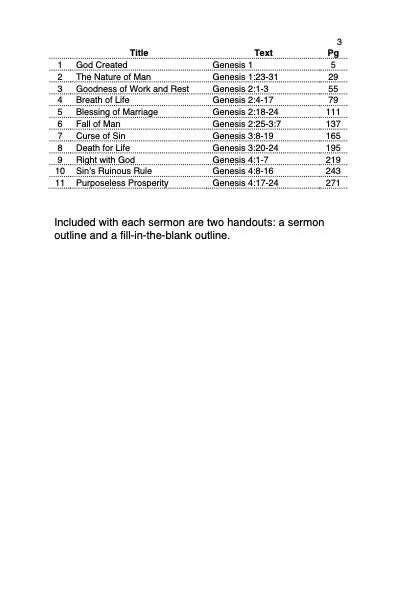
Death for Life is a theologically rich sermon manuscript on Genesis 3:20-24 that declares the foundational truth of penal substitutionary atonement: redemption and new life do not come through ignoring or excusing sin but through death and the substitutionary sacrifice of a righteous offering. This exposition carefully unpacks how God's response to Adam and Eve's sin foreshadows the redemptive work of Christ and establishes the pattern for salvation throughout Scripture.
In Death for Life, discover how the first act of redemption in Genesis 3:20-24 reveals the heart of the gospel—life through death, grace through judgment, and redemption through substitution.
When Adam named his wife Eve, and God clothed the guilty pair with garments of sacrifice, He foreshadowed the ultimate redemption found in Christ’s atoning death. This sermon traces the doctrine of penal substitutionary atonement from Eden to Calvary.
Through clear exposition and pastoral insight, this sermon outlines three principles of true redemption:
Redemption requires faith (v. 20). The sermon explores the significance of Adam naming his wife Eve, meaning "life" or "life-giver." This section examines how this naming demonstrates Adam's belief in God's promise from Genesis 3:15 that a descendant of Eve would defeat the serpent. It connects Adam's faith to Abraham's, showing that believing faith—evidenced by obedience—has always been required for righteousness before God.
Redemption requires a righteous sacrifice (v. 21). This section reveals the insufficiency of human effort, symbolized by the fig leaf coverings Adam and Eve fashioned for themselves. The sermon demonstrates how God rejected their self-made garments and instead provided coverings of animal skin—requiring the first death in Scripture. It traces how this sacrifice foreshadows the Mosaic sacrificial system and ultimately points to Jesus, the once-for-all sacrifice who imputes His righteousness upon the redeemed.
Redemption is a gift of grace (vv. 22-24). The sermon concludes with the surprising grace found in God's judgment. This section explores why God expelled Adam and Eve from the garden, preventing access to the tree of life. It powerfully demonstrates that what appears harsh was actually merciful—had they eaten and lived forever in their fallen state, they would have remained eternally condemned. God's expulsion made true redemption possible through the death and resurrection of Christ.
Perfect for pastors, teachers, and students of Scripture, this resource provides detailed outlines, exegetical notes, and rich theological application. It also includes hymn reflections such as “In Christ Alone” and “My Hope Is Built on Nothing Less,” connecting biblical exposition with gospel-centered worship.
Death for Life is a theologically rich sermon manuscript on Genesis 3:20-24 that declares the foundational truth of penal substitutionary atonement: redemption and new life do not come through ignoring or excusing sin but through death and the substitutionary sacrifice of a righteous offering. This exposition carefully unpacks how God's response to Adam and Eve's sin foreshadows the redemptive work of Christ and establishes the pattern for salvation throughout Scripture.
In Death for Life, discover how the first act of redemption in Genesis 3:20-24 reveals the heart of the gospel—life through death, grace through judgment, and redemption through substitution.
When Adam named his wife Eve, and God clothed the guilty pair with garments of sacrifice, He foreshadowed the ultimate redemption found in Christ’s atoning death. This sermon traces the doctrine of penal substitutionary atonement from Eden to Calvary.
Through clear exposition and pastoral insight, this sermon outlines three principles of true redemption:
Redemption requires faith (v. 20). The sermon explores the significance of Adam naming his wife Eve, meaning "life" or "life-giver." This section examines how this naming demonstrates Adam's belief in God's promise from Genesis 3:15 that a descendant of Eve would defeat the serpent. It connects Adam's faith to Abraham's, showing that believing faith—evidenced by obedience—has always been required for righteousness before God.
Redemption requires a righteous sacrifice (v. 21). This section reveals the insufficiency of human effort, symbolized by the fig leaf coverings Adam and Eve fashioned for themselves. The sermon demonstrates how God rejected their self-made garments and instead provided coverings of animal skin—requiring the first death in Scripture. It traces how this sacrifice foreshadows the Mosaic sacrificial system and ultimately points to Jesus, the once-for-all sacrifice who imputes His righteousness upon the redeemed.
Redemption is a gift of grace (vv. 22-24). The sermon concludes with the surprising grace found in God's judgment. This section explores why God expelled Adam and Eve from the garden, preventing access to the tree of life. It powerfully demonstrates that what appears harsh was actually merciful—had they eaten and lived forever in their fallen state, they would have remained eternally condemned. God's expulsion made true redemption possible through the death and resurrection of Christ.
Perfect for pastors, teachers, and students of Scripture, this resource provides detailed outlines, exegetical notes, and rich theological application. It also includes hymn reflections such as “In Christ Alone” and “My Hope Is Built on Nothing Less,” connecting biblical exposition with gospel-centered worship.

 Image 1 of 3
 Image 2 of 3
 Image 3 of 3