
The Lord Never Fails (Ruth 4:13–22)

The book of Ruth began with famine, death, and Naomi’s bitter return to Bethlehem. It ends with Ruth and Boaz’s marriage and the birth of their son, Obed. Naomi holds the child in her arms while her neighbors praise the Lord for His kindness. The closing genealogy then carries the story forward to King David.
Ruth 4:13–22 shows that the Lord was doing more than meeting Ruth and Naomi’s immediate needs. He restored hope to their family and, through the generations that followed, advanced His purpose to provide redemption from sin through Jesus Christ. The closing verses invite us to see God’s faithfulness across a much longer story than any one person can observe.
God worked through Ruth, a foreign widow who trusted Him, and through ordinary acts of faithfulness that others might have overlooked. Whatever our weakness or past, we can trust the Lord, obey His Word, and leave the lasting significance of our lives in His hands. The Lord never fails to accomplish His purposes.
More sermon resources:
How can the church endure when hostility is great and discouragement abounds? False teachers confuse the gospel, cultural Christianity offers false assurance, and the departure of those who once professed faith brings heartbreak to the church. In Enduring the Last Hour, 1 John 2:18–27 speaks directly to these concerns, calling believers to recognize those who oppose Christ and trust the provision God has made for His people.
Through careful exposition and pastoral application, this sermon examines the reality of antichrists, the difference between true saving faith and an empty profession, and the gracious work of the Holy Spirit in preserving believers in the truth. John’s warnings call the church to discernment, while his assurances direct our confidence to the Savior who knows and keeps all who are His. The church endures by the power of God alone.
Enhance your sermon engagement with this comprehensive 3-page study resource and listening guide for "Confident as Children" on 1 John 2:28-3:1.
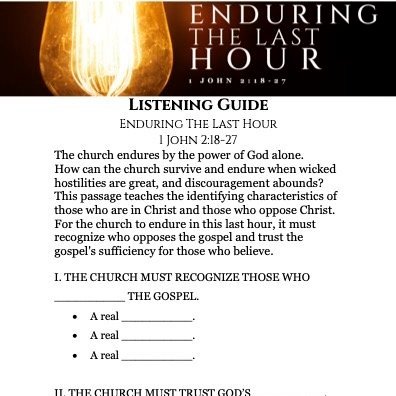
Enhance your sermon engagement with this comprehensive 3-page study resource and listening guide for "Endure the Last Hour" on 1 John 2:18-27.

The world continually competes for our love, tempting us to devote our time, attention, possessions, and lives to things that cannot last. Although salvation transforms what Christians love, believers must remain watchful against sinful desires, rebellious thoughts, and arrogant pride.
This expository sermon from 1 John 2:15–17 explains what it means not to love the world or the things of the world. John calls believers to give their hearts to what God loves, guard against worldly temptation, and devote their strength to God's eternal will.

Enhance your sermon engagement with this comprehensive 3-page study resource and listening guide for "Love what Lasts" on 1 John 2:15-17.
How can Christians know that their faith is genuine? False teachers may claim spiritual knowledge while their lives remain marked by disobedience, pride, and hatred. John teaches that genuine salvation produces visible evidence: a growing desire to obey God’s commands, love others as Christ has loved us, and mature in the faith.
This expository sermon from 1 John 2:7–14 explains how Christ gives believers a new understanding of God’s commands, a life that increasingly reflects God’s character, and encouragement toward spiritual growth. These evidences do not earn salvation; they reveal the transforming work of Christ in those who walk in His light.
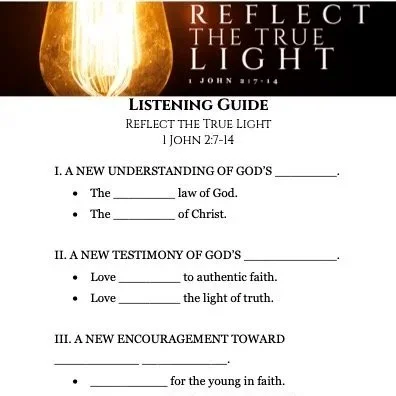
Enhance your sermon engagement with this comprehensive 3-page study resource and listening guide for "Reflect the True Light" on 1 John 2:7-14.
Christians who understand God’s holiness and recognize their own sin often wrestle with a painful question: How can I know that Christ is truly my advocate and that my sins are forgiven? The gospel neither minimizes sin nor grounds assurance in personal effort. It directs believers to Jesus Christ the righteous, whose atoning sacrifice satisfies God’s wrath and secures forgiveness for His people.
In this expository sermon on 1 John 2:1–6, Ben Smith explains how Christians receive assurance through an abiding relationship with Christ, obedience to God’s Word, and the transforming work of sanctification. The sermon distinguishes gospel obedience from legalism and encourages believers to find peace in what Christ has accomplished for their salvation and what He continues to do in their lives.
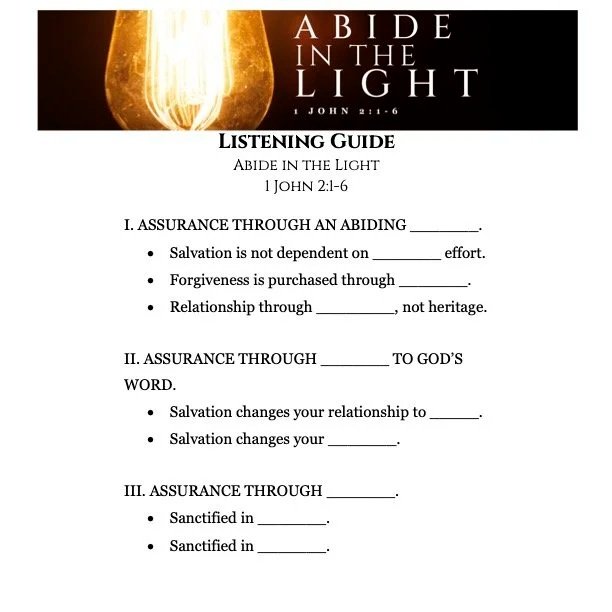
Enhance your sermon engagement with this comprehensive 3-page study resource and listening guide for "Abide in the Light" on 1 John 2:1-6.

The promise of Christ’s return raises a searching question: Can we stand before Him with confidence when nothing will be hidden from His judgment? For those who belong to Christ, the gospel provides lasting hope. Through His saving work, those who were once enemies of God have become His children, welcomed into His presence and assured of His love. This hope changes both how we anticipate eternity and how we live today.
In this expository sermon on 1 John 2:28–3:3, Ben Smith explains three ways abiding in Christ transforms believers: it gives lasting hope, produces confidence in love, and creates a desire for holiness. The sermon distinguishes righteousness as the evidence of regeneration from human efforts to earn salvation, encouraging Christians to rest in the Father’s love, trust His promises, and grow in likeness to Christ.