Four Reflections on the 2026 Southern Baptist Convention
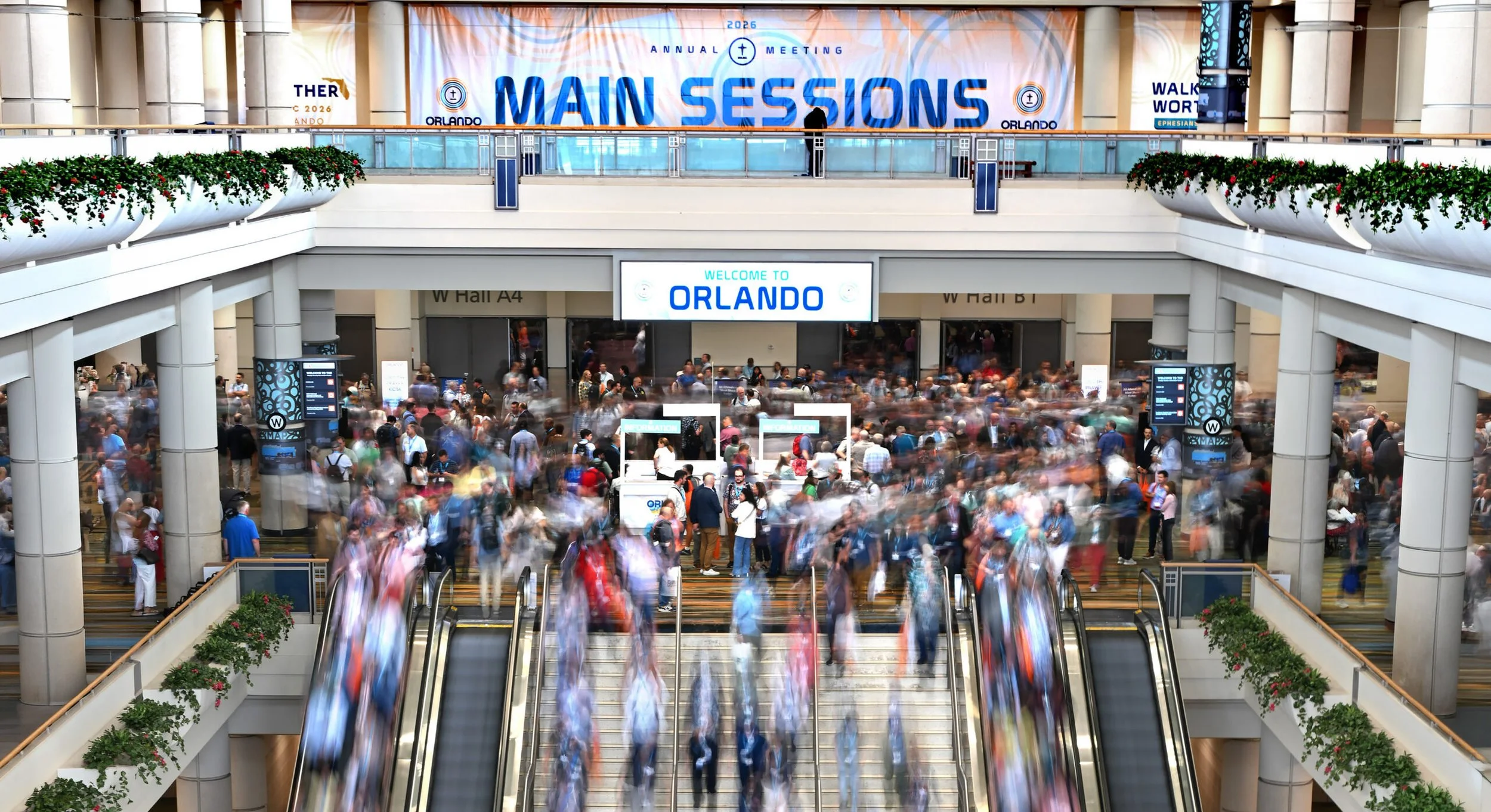
Photo by Roy Burroughs
On June 9-10, 2026, the Southern Baptist Convention gathered for its Annual Meeting in Orlando, Florida. There has been much discussion among Southern Baptists and others about the meeting's decisions. For those of you who are interested but were unable to attend the meeting, here are four things to help you make sense of what took place.
1. Polity and purpose are important.
A common frustration for anyone who attends the SBC annual meeting is how poorly the meeting's events are reported. Secular news outlets do not understand Baptist polity and regularly misrepresent, out of ignorance, what takes place at the SBC annual meeting. And those who do understand Baptist polity often do not understand what an annual meeting is and how it is governed, leading to misunderstandings about why something was done and why others were ignored.
The polity of the Southern Baptist Convention is unlike that of connectional denominations such as the Methodist and Presbyterian churches. Though it is proper to refer to these denominations as churches, such a designation is not appropriate for the SBC. The SBC is not a church but rather a voluntary association of autonomous churches. As such, the decisions made at the SBC annual meeting are not enforceable on individual churches, since the convention has no authority over them. The convention does define what is required to cooperate with it and, when necessary, can choose to break the relationship with a church deemed not to be in friendly cooperation.
The purpose of an annual meeting is to make decisions. Governed by parliamentary procedure, the annual meeting is a deliberative assembly (RONR 12th ed. 1:1) that allows messengers to debate and make decisions. There are always some expressions of frustration, and even accusations of unfairness, when messengers do not act on someone’s desired motion, or an action is ruled out of order. In a room of 11,692 messengers, all of whom have the ability to make motions, there will be some who hold unique positions and will sometimes make motions for things they are exclusively passionate about. However, the rules that govern deliberative assemblies are designed to protect the minority’s ability to debate and the majority’s ability to make decisions. Thus, when the body votes by two-thirds to end debate or to postpone a motion indefinitely (ending consideration of a motion), these are not deficiencies or errors, but the proper functioning of a deliberative assembly.
Unfortunately, much of the commentary about the SBC annual meeting either misrepresents or misunderstands what occurred because of a lack of understanding of Baptist polity or the purpose of a deliberative assembly. To understand what the Southern Baptist Convention is doing, why it is doing it, and how it is doing it, you must understand its polity and have a basic understanding of how a deliberative assembly operates.
2. Theological and doctrinal clarity is healthy and costly.
For generations, Southern Baptists have wrestled with the tension between practical and theological approaches to ministry. For various reasons, the pull of the practical has often been the stronger of the two. The practical stream looks for what seems most effective, and for Baptists who place much weight on numerical statistics, this is an alluring draw. However, this can lead to unhealthy assumptions, such as assuming that a numerically growing church is biblically faithful and doctrinally healthy, and that a numerically large church is the healthiest model for others to emulate.
The dominance of a practical approach to ministry among Southern Baptists has created a culture that is not well prepared for the trends now affecting churches. In previous days, when bigger was assumed to be better and if you built it, they would come, few asked questions concerning faithful ecclesiology. Pastors drank from the streams of the church growth movement, and biblical literacy among church members concerning what a church is, what the offices of the church are, how they are to function, and how the ordinances and church membership are to be administered grew weak.
There is reason to be encouraged. The casual observer may not always appreciate how good and healthy Southern Baptists engage in theological debate, but I contend this is the very thing that indicates health. I point to two things that support this assessment. Southern Baptists continue to engage energetically in how best to be faithful to Scripture, and there is growing enthusiasm for faithful ecclesiology.
Most of the reporting this year focused on the “Truth and Unity Amendment”, which would clarify how cooperating churches understand the office and function of pastor, elder, and overseer. I noticed that among the commentators who spoke negatively about this action, their arguments were mostly practical, related to secular culture’s view of gender, and to how the decision would affect the SBC’s acceptance in the culture. However, for those in the room, the concern was not how the SBC was being perceived in the world but how to most faithfully articulate the commands of Scripture. This is a good thing.
For the growing enthusiasm for faithful ecclesiology, I point to a 9Marks meeting that happened on Monday night, from 9 p.m. to well past 10 p.m. It was held in a large auditorium and featured a series of lectures on 12 propositions concerning the proper administration of church ordinances. It seems counterintuitive that after a long day of meetings and events, a late-night lecture event (yes, at my age, anything past 9 p.m. counts as late-night) on the subject of church ordinances could draw a crowd that would fill a large auditorium. Not only did the crowd fill the room, but they were also actively engaged in questions and discussions after each presentation.
I remember many years ago when 9Marks meetings were held in hotel conference rooms. The attendees were enthusiastic and engaged even then, but the meetings were small enough that the organizers could afford to give away a bundle of great books to everyone. Today, attendance has grown to the point that large auditoriums are required, and book giveaways are significantly less common (they remain part of 9Marks meetings, but the quantity is significantly limited). The growth in attendance is an encouraging sign, as it indicates growing awareness of the need to think more deeply about faithful ecclesiology. The SBC is only as healthy as its cooperating churches, and the churches are only as healthy as their faithfulness to Scripture.
Theological and doctrinal clarity is costly to your acceptance in the world, but healthy for our churches and our denomination as we strive to be obedient to God’s word.
3. Right direction but slow deliberation.
If you expect decisive and expedient decisions, you will be continually disappointed by the SBC. Issues of great consequence often require several years for the messengers of the SBC to reach a resolution. It is slow and deliberative, and sometimes frustratingly circuitous, but I am confident that the SBC is heading in the right direction.
The issue related to women serving in the office or function of pastor/elder/overseer is not new. During the conservative resurgence (1979-2000), this was a major issue that was addressed in Article VI, “The Church,” of the Baptist Faith and Message 2000. Since 2000, the messengers have consistently voted to disfellowship churches that violate this article. And in more recent years, as the issue of offending churches has begun to take up more time and attention at the annual meeting, there have been efforts to amend the constitution to clarify the matter more decisively.
Mike Law proposed a constitutional amendment addressing the issue in 2022. It came to the floor in 2023, was amended by Juan Sanchez, and received the required two-thirds affirmative vote (constitutional amendments require a two-thirds affirmative vote in two consecutive annual meetings). In 2024, when it came to the floor for the second vote, it received 61.45% of the vote but fell short of the required two-thirds.
Again, in 2025, Juan Sanchez proposed a revised version of the amendment. Though the messengers suspended the standing rules to allow the amendment to come to the floor that year, it received 60.74% of the vote but failed to reach the required two-thirds.
This year, Dr. Albert Mohler proposed a similar amendment, the “Truth and Unity Amendment.” The messengers suspended the standing rules to allow the amendment to come to the floor and approved it with a 74.7% affirmative vote. For the amendment to be adopted, the messengers of the 2027 Annual Meeting must also vote two-thirds in favor.
The SBC has been clear on this issue since 2000, but has continued to work out how best to articulate it in our confession and constitution. I am hopeful that the “Truth and Unity Amendment” will receive a two-thirds affirmative vote in 2027.
4. General observations.
More families and babies:
Years ago, when Dana and I were attending with infants, the stroller section was singular and small. This year, the stroller area was significantly expanded, and the large area at the back of the room was consistently occupied by kids playing all kinds of individual and group games. The SBC annual meeting is filled with young families with children. This is a good and encouraging thing.
Task forces are out:
In recent years, motion after motion has been made to establish various task forces to study and report on a wide range of issues. This year was no different; however, the messengers disposed of these motions differently. The standard procedure is to refer such motions to the appropriate entity; however, this year, the messengers decided to indefinitely postpone all motions related to task forces. I have not seen such action taken before, and I think it represents the growing fatigue messengers have with task forces.
Clear direction:
Though there is energetic debate, the messengers’ consistently high majority voting percentages indicate that the will of the convention remains clear.
Less hostility toward entities:
In recent years, messengers have expressed opposition and frustration toward certain entities and their leadership. Though there will never be unanimous approval for every decision made by entity heads, the temperature seems to have cooled significantly.
The room is different than the reporting:
I have attended the SBC annual meeting for over 20 years. Each time, I am surprised by how disconnected the reporting on the meeting is from the experience of those in the room. In all my years of attending the annual meeting, I have found the atmosphere congenial and respectful. And without fail, even in years when votes did not go the way I had hoped, I have left the Southern Baptist Convention encouraged and thankful.